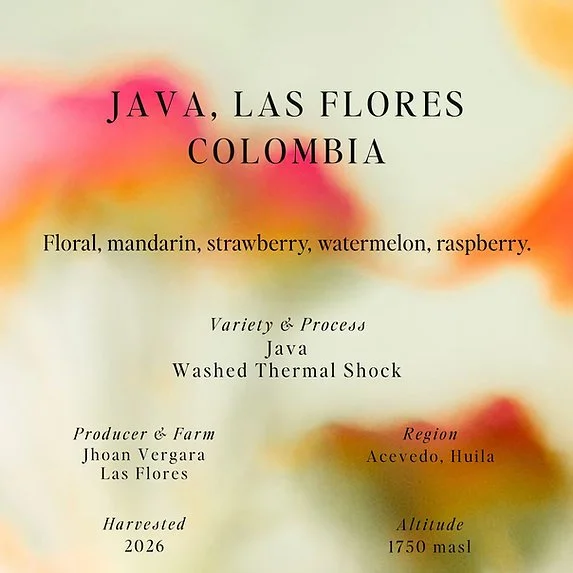
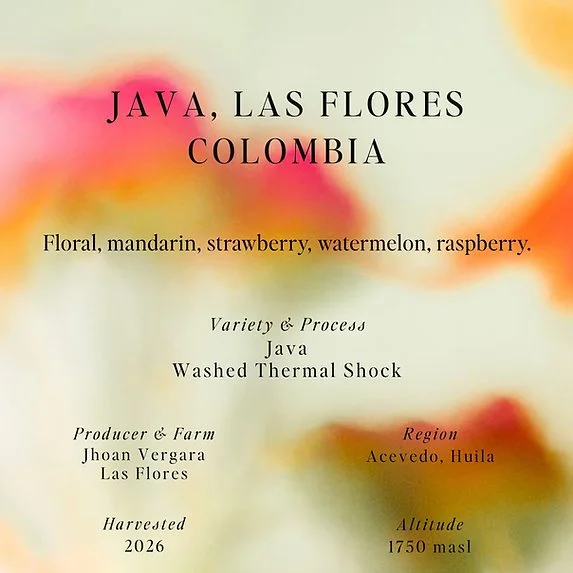
Java, Washed Thermal Shock, Las Flores, Colombia
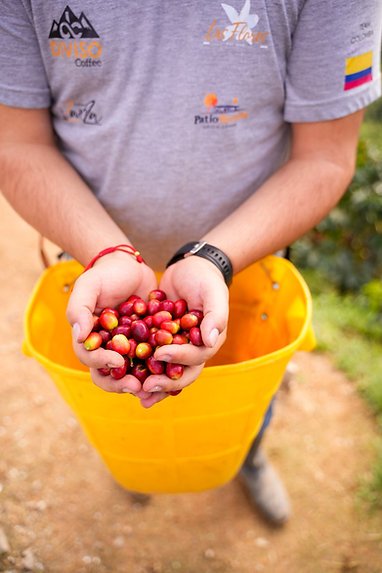
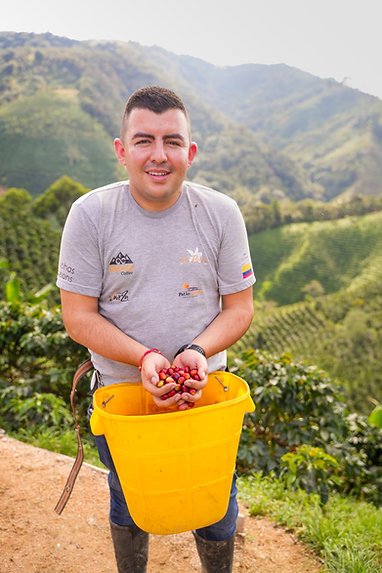
Finca Las Flores started as a dream in 1990 when Edilberto Vergara and Nubia Ayure planted their first coffee trees. With just 2 hectares dedicated to coffee, they worked hard to build a future for their family. By 1998, the farm was fully planted, and their five children - Xiomara, Leonardo, Carlos, Jhoan, and Diego - grew up immersed in the rhythms of coffee farming.

In 2006, Nubia’s passion and dedication led her to the Cup of Excellence, where she placed 16th - an achievement that encouraged the family to dive deeper into specialty coffee. As the years went by, Jhoan’s curiosity about coffee only grew. Wanting to understand every step of the journey from seed to cup, he studied at Sena, learning advanced agricultural practices and exploring the science behind coffee processing. This knowledge inspired him to renew the farm’s crops and introduce new varieties like Java, Pink Bourbon, Maracaturra, Castillo, Tabi, and Bourbon Sidra, each one offering unique flavors and adapting to the farm’s high-altitude environment.

Alongside his brothers, Jhoan took on a bigger role in refining the farm’s processes. Carlos and Diego focused on fermentation and drying techniques, ensuring consistency and quality, while Jhoan led experimentation and commercial outreach, helping their coffee reach new markets.

In 2019, Jhoan won first place in the Master of Coffee competition with a Pink Bourbon, competing against 162 participants. This victory gave him the chance to represent the farm in South Korea, where he won an international auction and introduced Finca Las Flores to the global specialty coffee scene.

Today, the farm stands as a model of sustainability, innovation, and commitment to excellence. Jhoan continues to push boundaries, not only perfecting coffee production but also sharing knowledge with future generations. For him, every cup of coffee is an opportunity to tell a story. A story of hard work, passion, and a deep love for the land.

Java is a rare Arabica variety with roots tracing back to Ethiopia before making its way through Indonesia and eventually into Central and South America. Often compared to Geisha for its elegant and refined cup profile, Java is celebrated for its floral aromatics, tea-like texture, and vibrant clarity. The variety is also prized by producers for its resilience and ability to produce exceptionally expressive coffees at high altitudes.-
V60
Coffee: 15g
Water: 225ml
Temperature: 88°C
Total Time: ~2:30
Grind Size: Fellow ODE Gen 2 : 7.2
Method
Rinse the paper filter, add 15g of coffee and gently level the bed
Bloom, add 50g of water
Wait 30 seconds
Pour up to 100g total by ~1:00
Keep a steady, controlled pour
Pour up to 160g. Maintain a slow, consistent flow,
Pour up to 225g avoid agitation
-
Producer: Jhoan Vergara
Farm: Las Flores
Region: Acevedo, Huila
Variety: Java
Process: Washed Thermal Shock
Altitude: 1750 masl
Harvested: 2026 -
Floral, mandarin, strawberry, watermelon, raspberry.
-
Roasting date : 22.06.2026
Freeze date : 4.07.2026
Curiosities
-
Coffee was first brought to Colombia in the early 1700’s by Jesuit priests who arrived with Spanish settlers. The first crops were harvested in the Northeast part of the country, but coffee was quickly adopted across the nation by small, family farms as a local cash crop.
The first commercial export of coffee didn’t occur until the first decade of the 1800’s. That first shipment of a humble 100 bags of green coffee (around 60kg each) was the first of what would become a major industry. As coffee consumption grew rapidly in The United States, Germany, and France in the mid-1800’s, so did Colombia’s coffee production.
The growing industry hit a brief decline in the late 1800’s as a civil war broke out in the country, called The Thousand Days War. The fighting, along with a lull in international coffee prices, forced many plantation owners to split up farmland among workers, giving locals ownership and autonomy over their own farms.
In the early 1900’s, the now peaceful Colombia created a logistics system that enabled rural, small-estate farmers to export their coffee more efficiently. This spurred a new age of growth and gave those newer farmers a way to keep producing.
In 1927, the National Federation of Coffee Growers of Colombia was created to protect the interests of coffee growers. This organization quickly came to represent a large portion of Colombian coffee farmers.
Over the next few years, Colombia thrived as a coffee producer and became the world’s 3rd largest exporter, behind only Brazil and Vietnam.
In the 50’s the FNC launched an ad campaign that would create a national icon and generate a thirst for Colombian coffee around the globe. The man who made it happen was Juan Valdez, a fictional character who would appear on a variety of ads to communicate the quality of Colombian coffee.
Juan Valdez and his loyal donkey, Conchita, have been beloved ever since. Many have claimed that this character has become “the Uncle Sam of Colombia”, though we’re honestly not sure if that’s a correct assessment.
-
Acevedo, Huila
Located in southern Huila, near the municipality of Pitalito, Acevedo has become one of Colombia's most respected specialty coffee origins. The region's combination of high elevations, volcanic soils, cool temperatures, and abundant water creates ideal conditions for producing coffees with exceptional sweetness, complexity, and balance.
Today, Acevedo is home to a growing number of innovative producers who combine meticulous farming practices with advanced processing techniques, making it one of the country's most exciting coffee-producing regions.
Growing Conditions
Elevation: 1,500–2,100+ masl
Rich volcanic soils
Cool mountain climate
Significant day-to-night temperature variation
Diverse microclimates created by the Andean topography
These conditions promote slow cherry development, resulting in greater sugar accumulation, higher density beans, and increased cup complexity.
Coffee Varieties
Acevedo produces a wide range of cultivars, including:
Caturra
Castillo
Pink Bourbon
Java
Gesha
Chiroso
Sidra
Tabi
Many farms dedicate small plots to exotic varieties destined for the specialty and competition markets.
Processing Innovation
While washed coffees remain the regional benchmark, producers increasingly experiment with:
Extended washed fermentation
Anaerobic fermentation
Carbonic maceration
Thermal shock
Natural processing
Honey processing
Yeast inoculation
The region has earned international recognition for using these techniques to enhance—rather than overshadow—the intrinsic quality of the coffee.
Typical Cup Profile
Washed coffees from Acevedo are often characterised by:
High sweetness
Bright citrus acidity
Red and yellow stone fruits
Caramel
Cane sugar
Milk chocolate
Floral aromatics
Juicy mouthfeel
Outstanding clarity and balance
Acevedo consistently produces coffees that combine vibrant fruit character with precision, making it one of Colombia's premier origins for both classic washed profiles and innovative experimental lots.
-
Java Variety
Despite its name, Java is not originally from the Indonesian island of Java. Its genetic lineage traces back to Ethiopian Arabica, which spread through Yemen before being cultivated extensively in Java during the Dutch colonial period. Today, the variety has found a new home in Colombia, where it has gained recognition for its outstanding cup quality and adaptability to high-altitude environments.
Java is prized for its elegant sensory profile, combining floral complexity with remarkable sweetness, clarity, and balance. While often compared to Gesha, Java expresses its own identity—typically offering a slightly fuller body and richer sweetness while maintaining exceptional transparency in the cup.
Agronomic Characteristics
Best suited to elevations between 1,600–2,100 masl
Medium to high productivity
Moderate resistance to coffee leaf rust (depending on growing conditions)
Excellent potential for specialty coffee production
Performs exceptionally well under slow cherry maturation
Typical Cup Profile
Java is known for its refined and layered sensory expression, often featuring:
White flowers
Orange blossom
Jasmine
Bergamot
Peach
Apricot
Mandarin
Grapefruit
Honey
Brown sugar
Black tea
Silky medium body
Bright, elegant acidity
Long, clean finish
Java performs beautifully across a range of processing methods. Whether fully washed or experimentally fermented, it often retains remarkable clarity, allowing both varietal character and terroir to shine.